F.C. Kohli Auditorium, Kanwal Rekhi Building (KreSIT), IIT Bombay
The Indian Institute of Technology Bombay is organizing an Institute Colloquium on Monday, January 19, 2026.
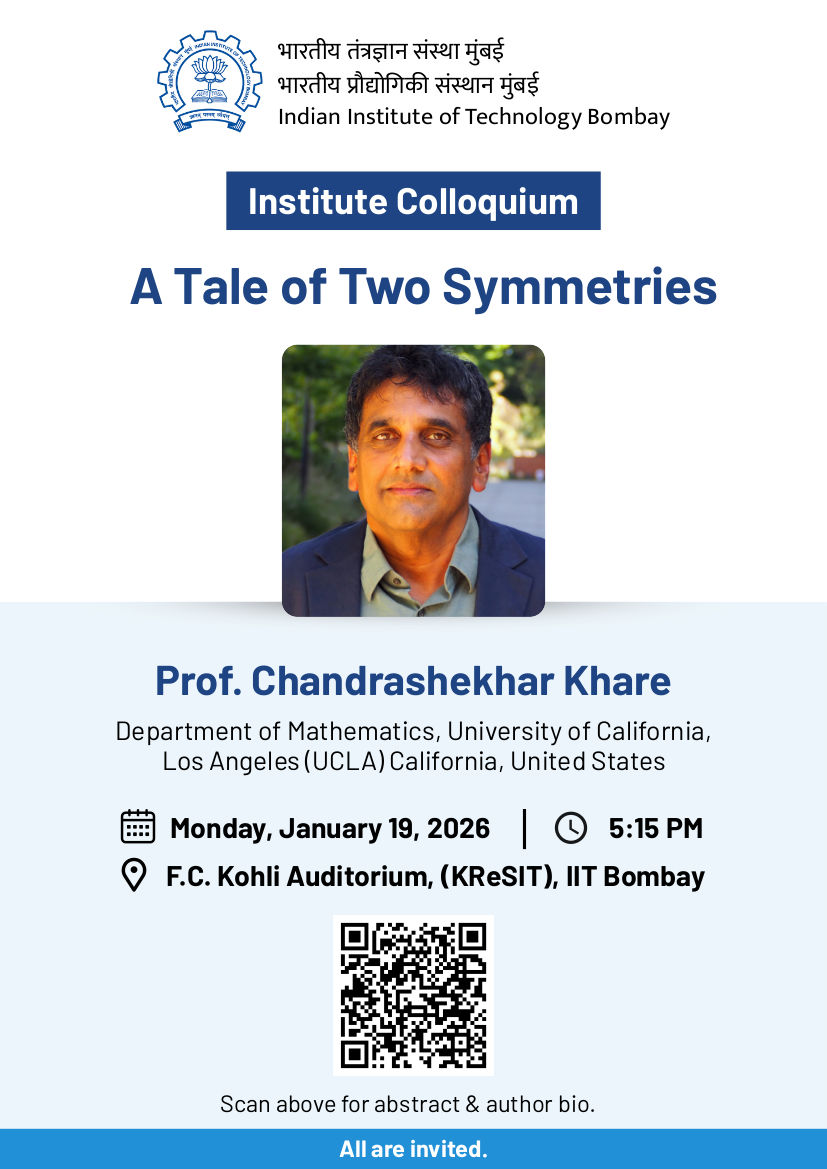
The details of the Colloquium are provided below:
Title: 'A Tale of Two Symmetries'
Speaker: Prof. Chandrashekhar Khare, Department of Mathematics, University of California, Los Angeles (UCLA),
California, United States
About the Speaker:
Prof. Chandrashekhar Khare was born in Mumbai, and studied at Cambridge, Oxford and Caltech, where he obtained his Ph.D. in 1995. He worked at the Tata Institute of Fundamental Research and the University of Utah and is now a professor at the University of California, Los Angeles. Prof. Khare's research is in number theory, especially on the relation between modular forms and Galois representations. In 2009, he and Jean-Pierre Winterberger made a remarkable breakthrough with their proof of a celebrated conjecture of J.P. Serre. Prof. Khare's honors and awards include the Fermat Prize (2007), Infosys Prize (2010) and the Cole Prize (2011), and he was elected as a Fellow of the Royal Society in 2012.
Speaker's webpage: https://www.math.ucla.edu/~shekhar/
Abstract:
I will trace the development of ideas from a 1916 paper by Ramanujan to the formulation of a conjecture by Jean-Pierre Serre in the 1970s, to its resolution in 2009 in my joint work with Jean-Pierre Wintenberger. Serre's modularity conjecture was a stimulus to much work that led to developments which were crucial to the methods Andrew Wiles used in his solution in 1994 of Fermat's Last Theorem. When Wiles announced his results, he had said that his methods were ``orthogonal'' to Serre's conjecture. Our proof of Serre's conjecture uses a strategy that relies crucially on Wiles's methods. The mathematics around Serre's conjecture and our solution of it remains a central area in Number Theory.
My mathematical memoir, Chasing a Conjecture: Inside the Mind of a Mathematician, discusses some of these ideas at an impressionistic level. This talk will give a more mathematical introduction to these ideas: it will flesh out the interplay of Galois and Ramanujan symmetries that are the main protagonists of my book.