P.C. Saxena Auditorium, IIT Bombay
The Indian Institute of Technology Bombay is organizing an Institute Colloquium on Thursday, February 12, 2026.
The details of the Colloquium are provided below:
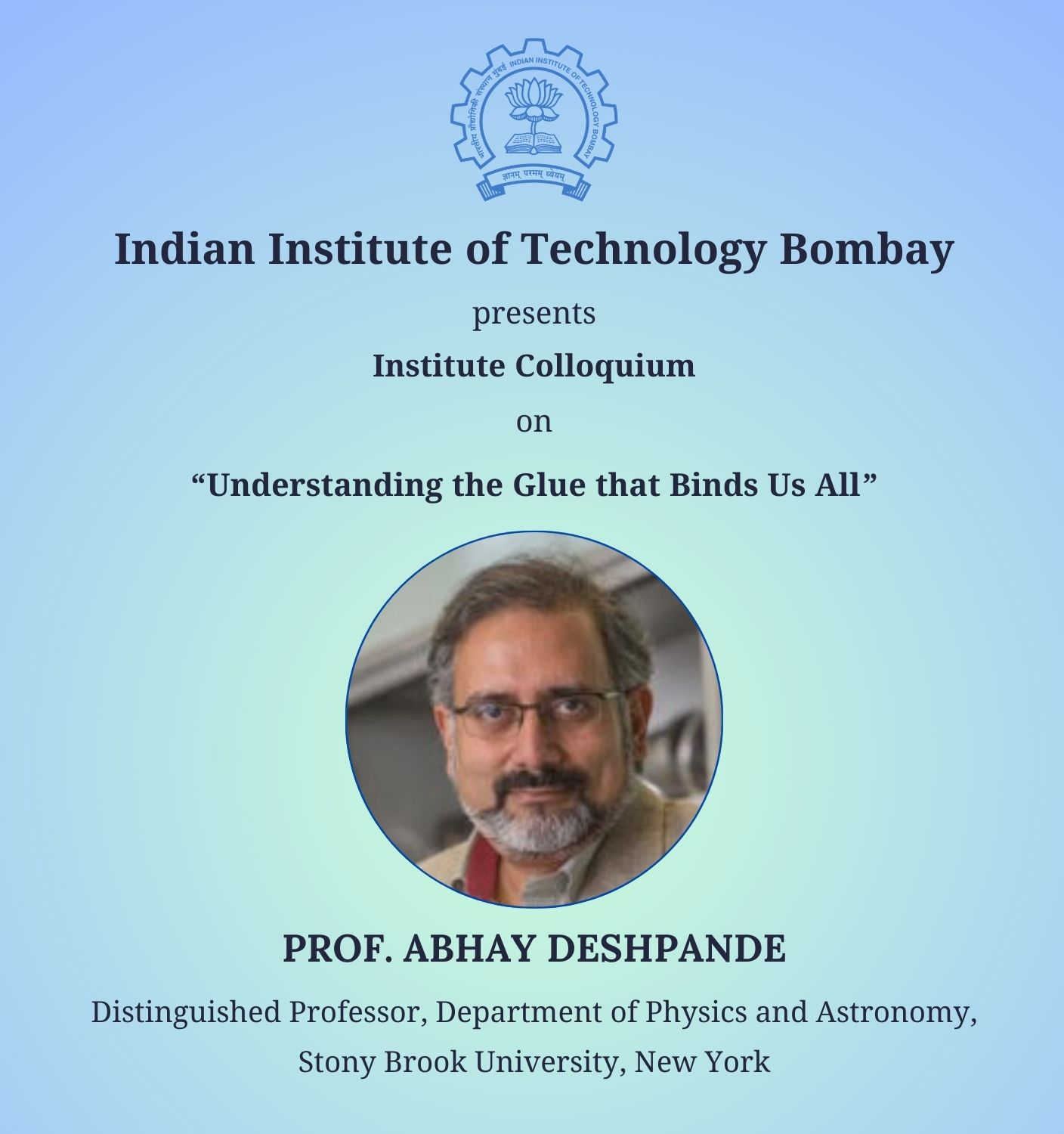
Title: Understanding the Glue that Binds Us All
Speaker: Prof. Abhay Deshpande, Distinguished Professor, Department of Physics and Astronomy, Stony Brook University, New York
About the Speaker:
Prof. Abhay Deshpande is a State University of New York (SUNY) Distinguished Professor in the Department of Physics and Astronomy at Stony Brook University. He also serves as interim Associate Laboratory Director for Nuclear and Particle Physics & Director of Science for the Electron Ion Collider (EIC) at Brookhaven National Laboratory (BNL). He is the Founding Director of the Center for Frontiers in Nuclear Science (CFNS), set up jointly by BNL and Stony Brook University. Abhay studies the quark-gluon structure and dynamics inside the protons and nuclei to understand Quantum Chromodynamics (QCD), the theory of strong interactions within the Standard Model of physics. He also uses precision electroweak probes to explore the limits of the Standard Model (SM) of physics and search for effects beyond it. Abhay has been involved and led nuclear/particle physics experiments at BNL (Upton, NY, USA), CERN (Geneva, Switzerland), DESY (Hamburg, Germany), Jefferson Laboratory (Newport News, Virginia, USA), and PSI (Zurich, Switzerland). He is one of the first proponents of the Electron Ion Collider (EIC) at the time called the eRHIC since 1996, and has been a leader in developing the EIC science, making the case for it, initiating, and organizing the Users Community and detector collaborations around this project.
Prof. Abhay received his Master’s in physics from Indian Institute of Technology (Kanpur, India) in 1987, Ph.D. from Yale University in experimental high-energy particle physics in 1994. After spending four years at CERN and DESY as a postdoctoral fellow and research scientist, he became a Fellow of the RIKEN BNL Research Center at BNL in 2000. He moved to Stony Brook University as tenure track Assistant Professor at Stony Brook University in 2004, promoted to Associate Professor with tenure in 2008, Professor in 2013, and finally appointed State University of New York’s highest professorship, “Distinguished Professor” in 2021. Abhay is a Fellow of the American Physical Society (APS, 2014) and American Association for Advancement of Science (AAAS, 2021). He is a recipient of a Special Prize by the President of RIKEN for his research at RHIC (2015), SUNY Chancellor’s Award for Excellence in Research & Innovation (2018), IIT Kanpur’s Distinguished Alumnus Award (2021). Abhay was inducted into NY State’s Distinguished Academy (2022). Abhay serves on the advisory boards of various national and international conferences, research centers and institutions. Abhay is a life member of the American Association for Advancement of Science (AAAS) and American Physical Society (APS).
Prof. Abhay Deshpande works in experimental nuclear and high energy physics. His current research includes various exploratory and precision studies in QCD using polarized proton-proton, proton-nucleus and nucleus-nucleus beams of the Relativistic Heavy Ion Collider (RHIC) at Brookhaven National Laboratory on Long Island; and high intensity polarized electron beams of the recently upgraded Continuous Electron Beam Accelerator Facility (CEBAF) at Thomas Jefferson National Laboratory, in Newport News, Virginia. He has been involved deeply in the development of the science and promotion of the future Electron Ion Collider.
Speaker's webpage:
https://www.stonybrook.edu/commcms/physics/people/_profiles/deshpandea…
Abstract:
Despite half a century of international research, scientists still understand very little about the interactions between quarks and gluons inside protons and neutrons especially when they are in large numbers. For instance, adding up the masses of quarks and gluons accounts for only about 1% of a proton's total mass and roughly half of its spin. Where does the rest come from? The answer likely lies in the complex dynamics of gluon interactions. To explore the gluon's role, a groundbreaking new facility—the Electron-Ion Collider (EIC)—is being built at Brookhaven National Laboratory in partnership with Jefferson Lab. This next-generation particle accelerator will collide polarized electrons with polarized protons and nuclei to produce high-resolution "snapshots" of their internal structure (think of a 3D MRI of the proton), enabling physicists to better understand how quarks and gluons generate mass, spin, and the fundamental properties of matter. The EIC is a global collaboration involving more than 1,500 scientists from nearly 300 institutions, including a significant contingent from India. Once operational later in the next decade, the collider is expected to revolutionize understanding of the strong nuclear force—the "glue" that binds the building blocks of visible matter throughout the universe. In this talk, I will outline the open questions in quark–gluon dynamics and present the current status of the EIC project that is poised to address them.