F.C. Kohli Auditorium, Kanwal Rekhi Building (KReSIT).
The Indian Institute of Technology Bombay is organizing an Institute Lecture on Wednesday, January 21, 2026.
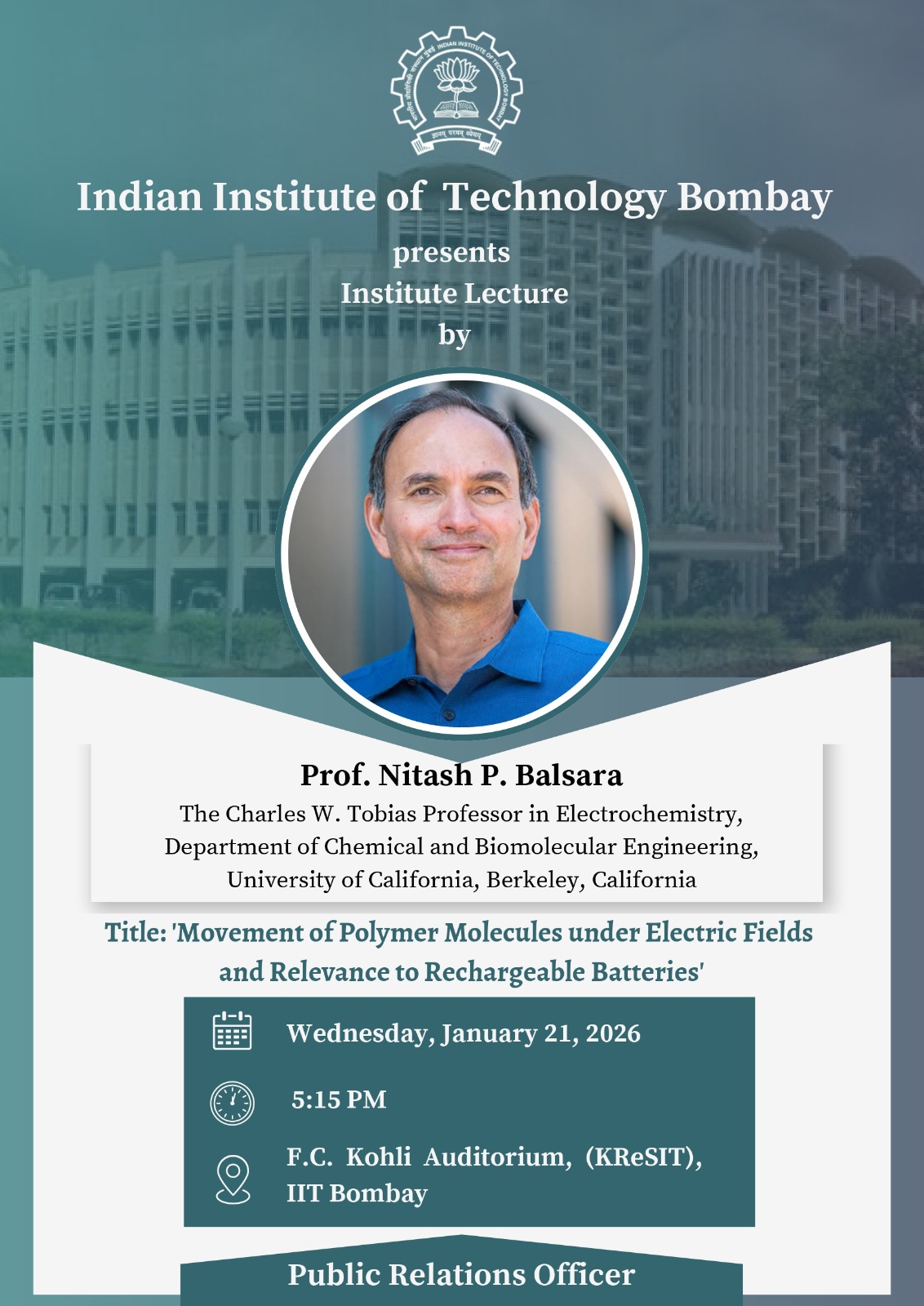
The details of the Lecture are provided below:
Title: 'Movement of Polymer Molecules under Electric Fields and Relevance to Rechargeable Batteries'
Speaker: Prof. Nitash P. Balsara, The Charles W. Tobias Professor in Electrochemistry, Department of Chemical and Biomolecular Engineering, University of California, Berkeley, California
About the Speaker:
Nitash P. Balsara is a chemical engineer with a bachelor's degree from the Indian Institute of Technology in Kanpur, India in 1982, a master's degree from Clarkson University in Potsdam, New York in 1984, and a PhD from Rensselaer Polytechnic Institute in Troy, New York, in 1988. He did post-doctoral research at the Department of Chemical Engineering and Materials Science at the University of Minnesota, and at Exxon Research and Engineering Company in Annandale, New Jersey. In 1992, he joined the faculty of the Department of Chemical Engineering at Polytechnic University in Brooklyn, New York. In 2000, he moved to the Department of Chemical Engineering at the University of California, Berkeley, with a joint appointment at Lawrence Berkeley National Laboratory. He works at the intersection of polymer physics and electrochemical energy storage. He cofounded two battery start-ups, Seeo (purchased by Bosch) and Blue Current (currently operating with 50 employees). He received the Polymer Physics Prize (2026) and John H. Dillon Medal (1997) for Polymer Physics from the American Physical Society, the Stine Award for Materials Science from the American Institute of Chemical Engineers (2005), the Hottel Lectureship from the Massachusetts Institute of Technology (2015), the Van Ness and Birnboim Lectureships from Rensselaer Polytechnic Institute (1998 & 2025), the Charles W. Tobias Endowed Chair in Electrochemistry at the University of California, Berkeley (2014-present), the Platinum Jubilee Professor of the Indian Academy of Sciences (2014), the Distinguished Alumni Award from the Indian Institute of Technology, Kanpur (2019), and the United States Energy Secretary's Achievement Award (2018).
Speaker's webpage: https://chemistry.berkeley.edu/people/nitash-balsara
Abstract: It is natural to focus on the movement of charged ions in electric fields. In this talk however, I will focus on the movement of neutral "solvent" molecules used to dissolve the ions inside batteries. Any energy used to move solvent molecules is wasted, and thus it is important to understand how and why they move. In our case, the solvent is a polymer; I believe that polymer electrolytes will play an essential role in enabling next-generation rechargeable batteries. My journey began when I learned about the continuity equation as an undergraduate student. I will describe how the continuity equation changes in the presence of an electric field. While ion velocities can be inferred from current-voltage measurements, there were no well-established approaches for measuring velocities of neutral molecules in batteries. My group (and others) have recently developed experimental approaches for accomplishing this. Surprisingly, the field-induced velocity of uncharged long polymer chains is comparable to that of the ions. If the polymer chains are crosslinked, then the movement of ions generates stress that opposes ion motion. Theoretical predictions will be compared with experimental results. In addition to continuum-scale experiments, I will describe the results of quasi-elastic neutron scattering experiments, which enable the study of the motion of polymer segments in the vicinity of ions on the Angstrom length scale. These measurements and computer simulations on the same length scale provide insight into the underpinnings of continuum transport. I will conclude by describing the connection between our work on polymer electrolytes and the continuing push to commercialize all-solid rechargeable batteries for electric vehicles and other energy-related applications.