F.C. Kohli Auditorium, Kanwal Rekhi Building (KReSIT), IIT Bombay
The Indian Institute of Technology Bombay is organizing an Institute Colloquium on Friday, October 17, 2025.
The details of the Colloquium are provided below:
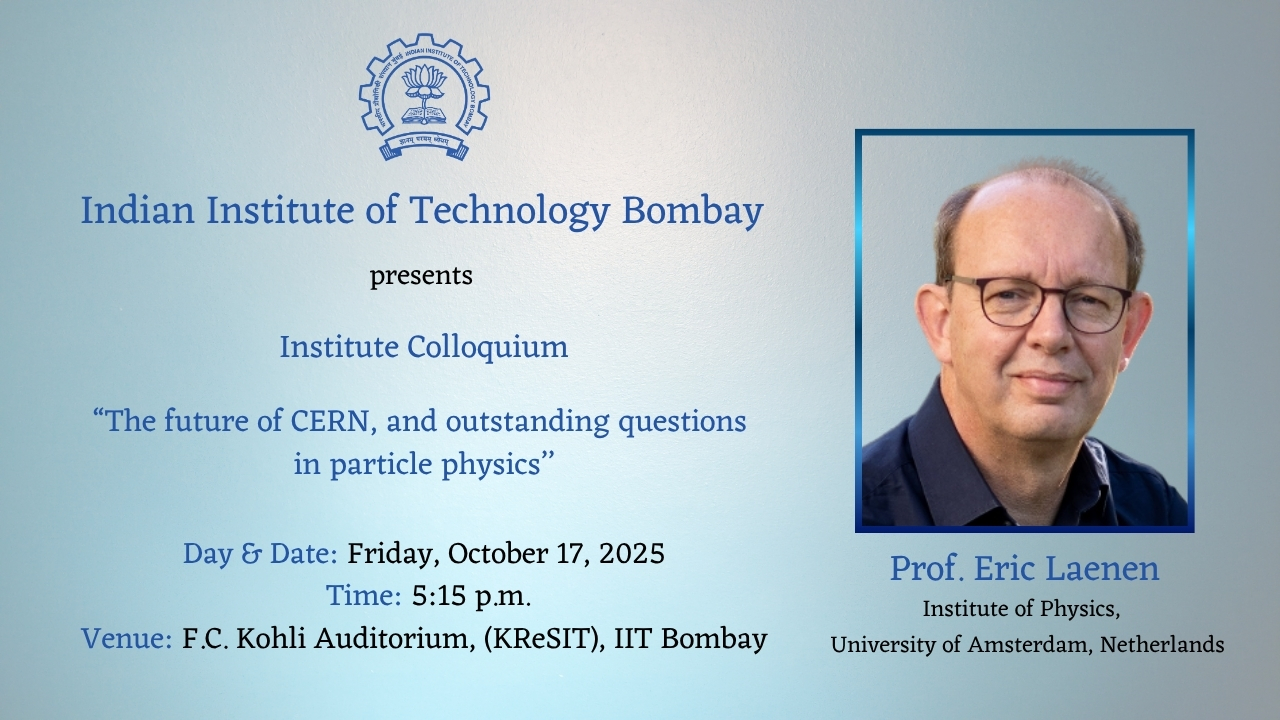
Title: "The future of CERN, and outstanding questions in particle physics"
Speaker: Prof. Eric Laenen, Institute of Physics, University of Amsterdam, Netherlands
About the Speaker:
Dr. Eric Laenen is a Professor of Theoretical Physics at the University of Amsterdam and Utrecht University and a Senior Scientist at Nikhef in Amsterdam. He currently serves as Director of the Institute of Physics at the University of Amsterdam and has held key leadership roles at CERN and advisory board memberships, including Vice President of the CERN Council. Prof. Laenen was a member of the Task Force 2022 from CERN, which evaluated India's contribution to the CERN programs. He is also a member of the global particle physics committee to shape the future strategy for CERN.
With a Ph.D. from Stony Brook University and fellowships at CERN and FERMI LAB, Prof. Laenen has published over 100 research papers, delivered invited lectures worldwide, and held visiting professorships at leading institutions, including Infosys Visiting Chair Professor at the Indian Institute of Science Bangalore, and visiting professor at the Indian Institute of Technology, Hyderabad. He has recently been elected a foreign fellow at NASI.
For more, please visit the Speaker's webpage: https://www.uva.nl/profiel/l/a/e.l.m.p.laenen/e.l.m.p.laenen.html?cb#Pr…
Abstract:
CERN, in Geneva, Switzerland, is the world's largest laboratory for particle physics and a beacon of international collaboration, with member states from across the globe, including India, contributing engineers, scientists, and ideas. At its heart lies the Large Hadron Collider, the most powerful particle accelerator ever built, whose experiments have yielded profound insights into the fundamental laws of nature, most famously the discovery of the Higgs boson in 2012. Today, the global particle physics community at CERN is shaping the next European Strategy for Particle Physics, a process that may chart the course toward a new flagship collider to succeed the LHC. In this colloquium, I will review where we stand in our understanding of the fundamental building blocks of matter, explain how long-term strategy in our field is developed, and highlight some of the outstanding questions about the Universe that we hope to address in the years ahead.