IITB researchers develop novel method to test the ‘quantumness’ of gravity
Researchers have suggested that gravity could hide its quantum nature by freezing its motion, rendering traditional entanglement tests insufficient, and have proposed a new measurement tool to detect these hidden signatures.
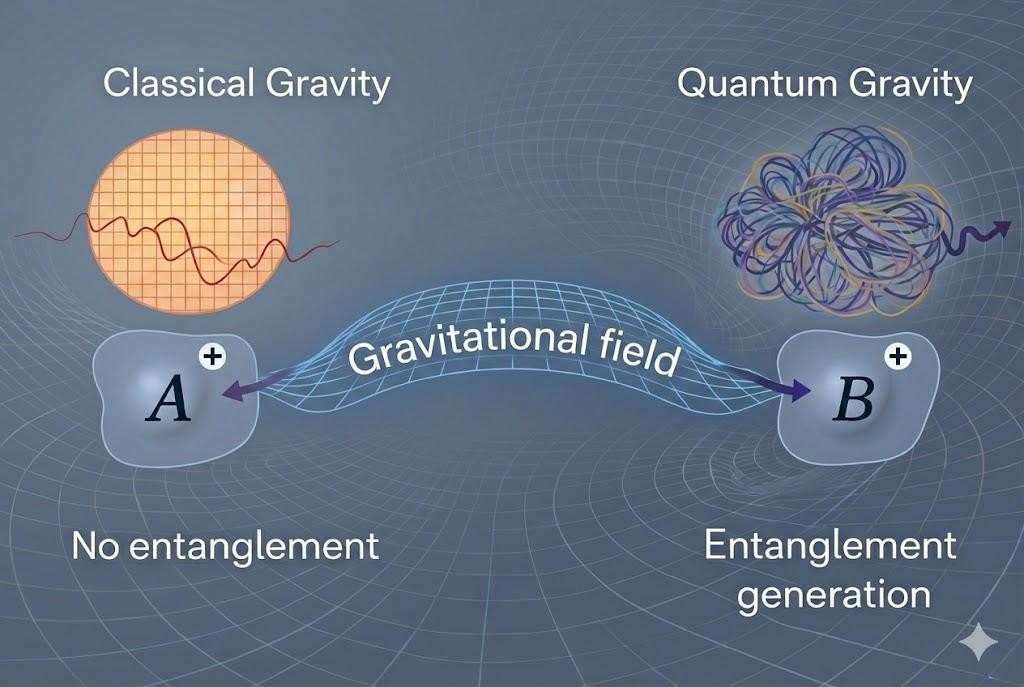
Researchers at the Indian Institute of Technology (IIT) Bombay have found a potential blind spot in our quest to prove that gravity follows the laws of quantum mechanics. In a new study, researchers P. George Christopher and Prof. S. Shankaranarayanan demonstrate that gravity could be fundamentally quantum even if it fails a long-standing test known as the entanglement test. The team has also proposed a new diagnostic tool called dynamical fidelity susceptibility (DFS), which serves as a more sensitive probe of the true nature of the universe's most mysterious force.
For over a century, theoretical physics has been a house divided. We have two incredibly successful theories for how the universe works. On the one hand, classical physics and general relativity, Albert Einstein’s seminal work, explain the big stuff, like planets, stars, and galaxies. It describes gravity not as a force but as a curvature of continuous, flexible fabric called spacetime.
On the other hand, quantum physics explains the rules of atomic and subatomic domains. In this world, particles can behave as waves and be in multiple locations or ‘quantum states’ at the same time. Despite being highly successful within their respective domains, both theories fail when the two domains collide, such as inside a black hole.
Physicists realised that one way to reconcile the two theories is to demonstrate that gravity, like the other fundamental forces of nature, is quantum in nature. This would mean that gravity is not the curvature of spacetime but a force mediated by particles called gravitons. This is analogous to how particles of light, or photons, produce the electromagnetic field. If gravity can be shown to be following quantum rules, we would finally have a “Theory of Everything”, a single set of equations that explains how everything moves, from atoms and cricket balls to stars and galaxies.
To test the quantum nature of gravity, the Bose-Marletto-Vedral (BMV) experiment was proposed in 2017. The experiment relied on a quantum property known as entanglement. Quantum entanglement is a phenomenon in which pairs of particles, such as photons and electrons, become so deeply linked that their properties become interdependent and they are described as a single entity sharing a single quantum state. This means that measuring the properties of one particle instantaneously determines the properties of its entangled partner, regardless of the distance between them. The BMV experiment suggested a simple test: if two masses that are initially in a spatial superposition of different states become entangled, and they only interact through gravity, then gravity itself must be quantum.
“The BMV proposal was unique because, for the first time since Feynman and DeWitt, it proposed a laboratory-accessible way to probe quantum aspects of gravity, unlike most quantum gravity tests, which require Planckian energy scales (around 1.96 *109 Joules) far beyond our current experimental reach,” remarks George Christopher.
An inference that can be drawn from the BMV experiments is that if we fail to observe entanglement between masses, then gravity must not be quantum. In their new study, the IIT Bombay team argues that such an inference might be flawed and ignores the subtleties of the properties of gravitons. Their study shows that a quantum mediator, like gravity, can become sluggish and frozen, appearing classical while remaining quantum at its core.
The researchers reached this conclusion by creating a mathematical model involving three harmonic oscillators. Think of these as three balls, A, B and C, connected by springs in a line. The two balls at the ends (A and C) are masses that do not touch one another and communicate only through the central ball (B), which serves as a mediator. This middle ball represents the gravitational field.
By varying the properties of this mediator, the team identified two distinct scenarios. Under a Light Mediator Regime (LMR), the mediator moves freely and readily induces entanglement between the two end balls. However, under a Heavy Mediator Regime (HMR), the mediator becomes so sluggish that its motion effectively freezes, behaving as a static background.
“In our model, the mediator is still fundamentally a quantum-mechanical oscillator, in the sense that it has quantum properties like a Hilbert space, zero-point fluctuations, and well-defined quantum states. However, in the Heavy Mediator Regime, the mediator exhibits strong self-interactions and a large effective mass, leading to a highly stiff dynamical response,” explains Prof. S. Shankaranarayanan.
This means that if gravitons are a heavy mediator, we may not detect entanglement between masses, even though gravity remains fundamentally quantum. This also makes the BMV experiment, and by extension, quantum entanglement, a less effective tool at probing the quantumness of gravity.
To address this, the team proposed a more sensitive probe of gravitons called the dynamical fidelity susceptibility. The phenomenon is analogous to a concept in classical thermodynamics called thermodynamic susceptibility, which measures a system's sensitivity to changes in external parameters, like temperature and pressure.
Here, rather than simply checking whether the masses are linked or entangled, the dynamical fidelity susceptibility method quantifies how the system’s quantum state evolves over time in response to infinitesimal microscopic perturbations. Their research shows that even when gravity is frozen and entanglement is negligible, this new measurement can still pick up the fingerprints of its quantum nature. The new method also offers experimentalists a new way to test whether gravity is indeed quantum.
“In principle, one could estimate fidelity by preparing an initial quantum state of the masses, allowing them to evolve under the gravitational interaction, and then measuring the overlap between the evolved state and the original one”, explains Prof. S. Shankaranarayanan.
The study provides a roadmap for future quantum gravity experiments. It ensures that even if we don’t find entanglement between masses, we don't inadvertently abandon the idea of the quantum nature of gravity. Moreover, the DFS method provides a more precise tool for predicting the exact mass range to which gravity belongs.
“Both the Light Mediator Regime (LMR) and Heavy Mediator Regime (HMR) can, in principle, mediate quantum correlations. Observing entanglement alone does not reveal which dynamical regime the mediator is operating in. DFS, on the other hand, is sensitive to the mediator’s dynamical properties and exhibits qualitatively different behaviour in LMR and HMR, allowing one to distinguish these regimes even when entanglement is negligible,” concludes George Christopher.
| Article written by: | Dennis Joy |
| Image/ Graphic Credit: | Pictorial representation of the experiment. Credit: Prof S Shankaranarayanan and NanoBanana |
| Link to Gubbi Labs: | -- |
