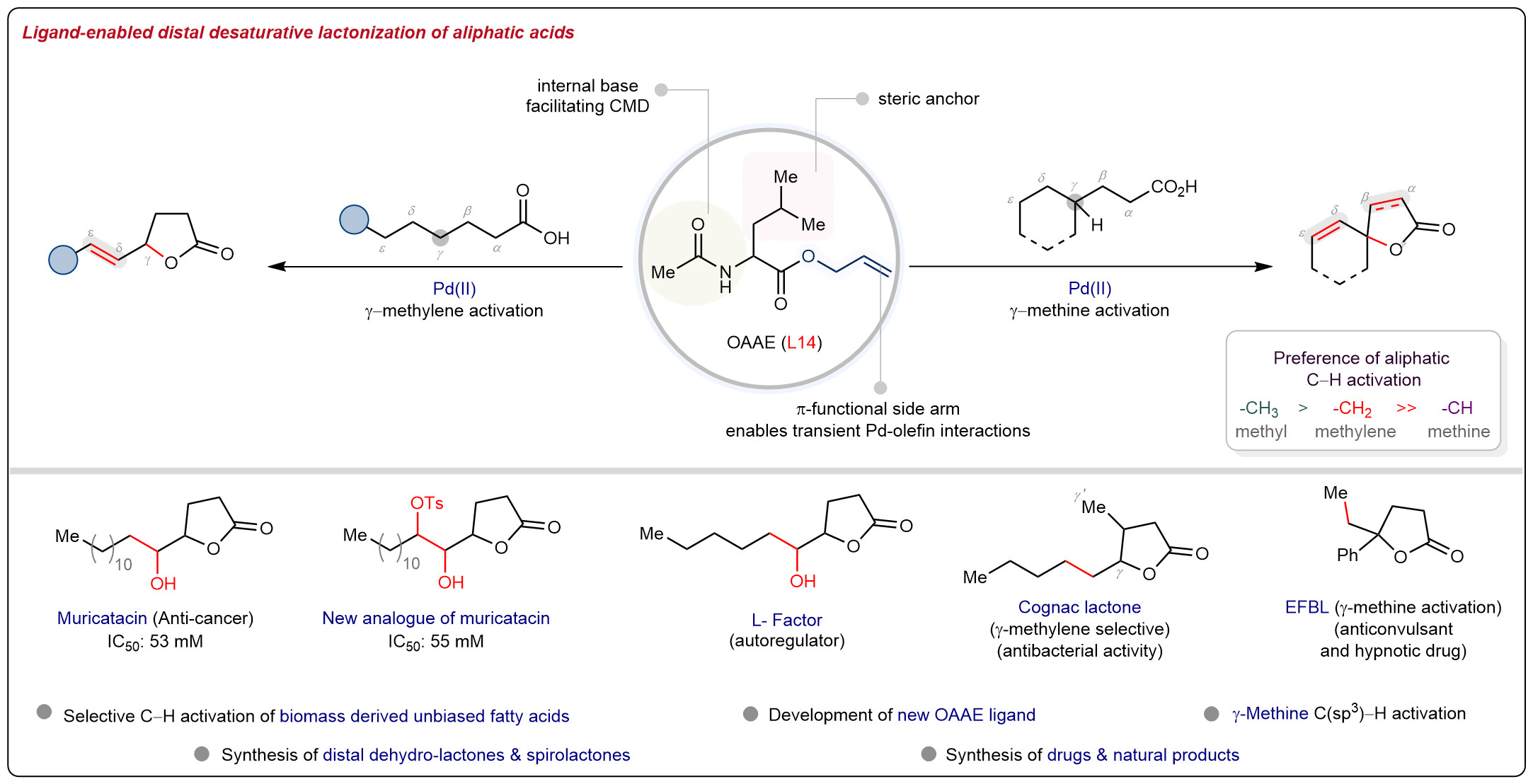
Ligand-enabled distal desaturative lactonization of aliphatic acids
Indian Scientists Develop Efficient Strategy to Convert Saturated Fatty Acids into Drug-like Molecules
A team of Indian scientists has developed a simple and highly efficient strategy to convert saturated fatty acids-one of nature’s most abundant chemical feedstocks-into a wide range of biologically active molecules and potential drug candidates. Their study has been published in the prestigious journal Nature.
The research was led by Prof. Debabrata Maiti, recipient of the Shanti Swarup Bhatnagar Prize (2023), at the Indian Institute of Technology Bombay.
For decades, converting saturated fatty acids directly into complex, useful molecules has been a major challenge in chemistry. These saturated fatty acids are cheap and widely available, but their chemical “inertness” makes them difficult to modify. The newly developed method overcomes this problem, allowing scientists to transform saturated fatty acids in fewer steps, with higher efficiency and less chemical waste.
Importantly, the work is not limited to a single molecule. Using this strategy, the researchers successfully synthesized more than ten biologically active compounds. These include muricatacin, Lfactor, cognac lactone, DL-NBP, EFBL, and several others. Together, these molecules cover a wide range of applications, such as medicinal chemistry, chemical biology, and the perfume and flavour industries. Some of these compounds are known for their roles as autoregulators in biological systems, some are important building blocks for pharmaceuticals, while others are widely used for their aroma and flavour properties. This demonstrates the broad usefulness of the method across different industries, rather than for one specific target.
The research team includes IIT Bombay PhD scholars Tanay Pal, Md Saimuddin Sk, and Animesh Ghosh, along with Research Assistant Yazhinimuthu C. M. They also collaborated with Somnath Kar from the Bhabha Atomic Research Centre, Mumbai.
One of the key highlights of the study is the rapid laboratory synthesis of Muricatacin, a natural product found in Laxman phal (soursop), which has attracted attention for its potential anticancer activity. Extracting muricatacin from nature is extremely inefficient-about 15 kg of plant material is needed to obtain just 15 mg of the compound, and even then it comes mixed with many other substances. The new synthetic approach provides a clean and practical alternative. The team also prepared new analogues of Muricatacin, one of which showed anticancer activity comparable to the natural compound in early biological tests.
According to Prof. Maiti, the importance of this work lies in its general nature. The method acts as a platform that can quickly convert simple saturated fatty acids into many different bioactive molecules. This could help scientists study and improve compounds used in traditional medicine systems such as Ayurveda, and speed up their development into modern drugs.
The breakthrough was enabled by a newly designed ligand called OAAE. When combined with a palladium catalyst, this ligand works like a molecular clamp, selectively activating a specific carbon– hydrogen bond in the saturated fatty acid chain—something that chemists have struggled to achieve for many years.
The researchers believe this strategy could make drug discovery faster, cheaper, and more sustainable. In the long run, it may also change how medicines and fine chemicals are produced, by shifting industries toward renewable and readily available saturated fatty acids as starting materials.
Full study: https://rdcu.be/fqvVD