P.C. Saxena Auditorium, IIT Bombay
The Indian Institute of Technology Bombay is organising an Institute Lecture on Monday, October 13, 2025.
The details of the lecture are provided below:
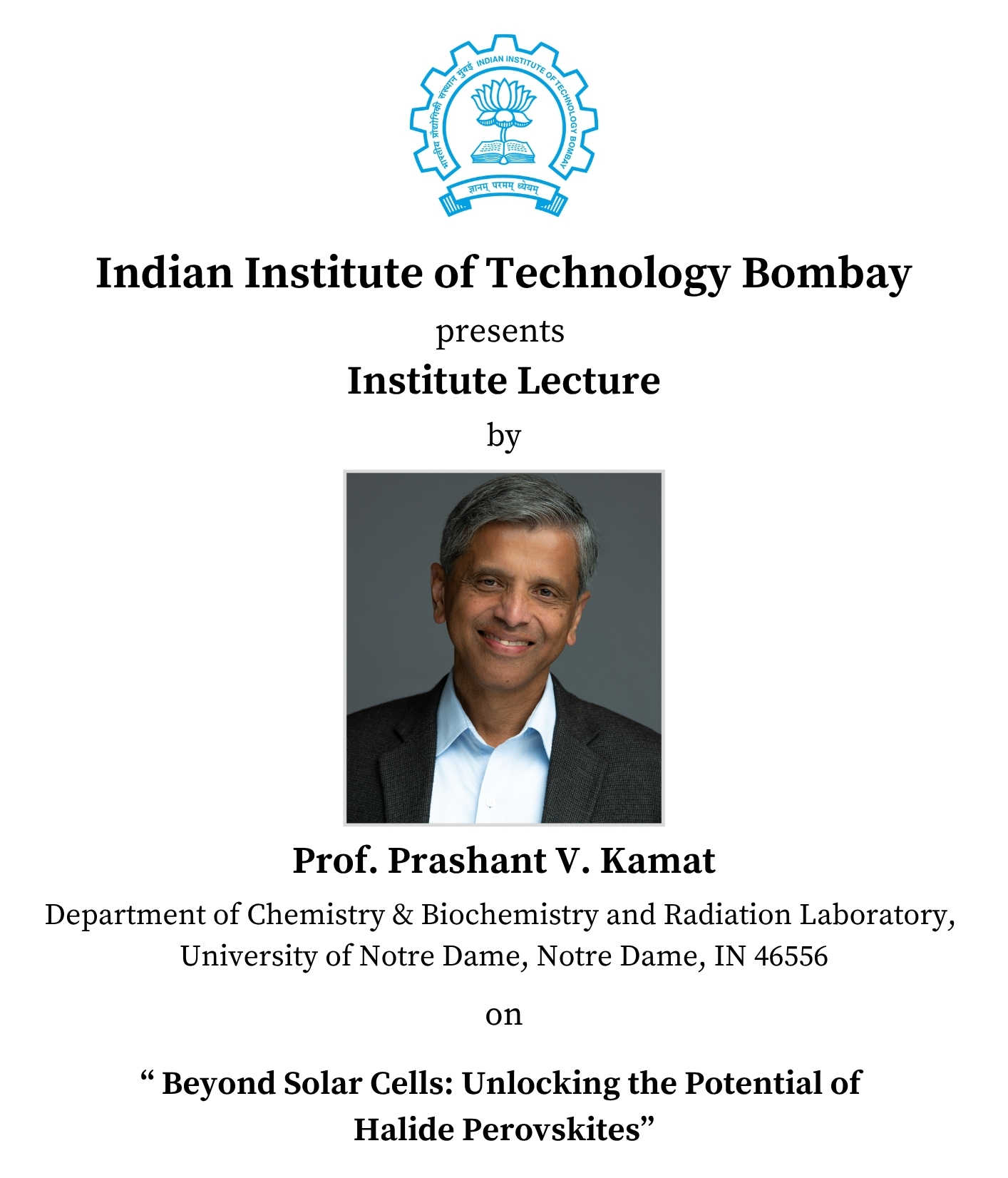
Title: "Beyond Solar Cells: Unlocking the Potential of Halide Perovskites"
Speaker: Prof. Prashant V. Kamat, Department of Chemistry & Biochemistry and Radiation Laboratory, University of Notre Dame, Notre Dame, IN 46556.
About the Speaker:
Prof. Prashant V. Kamat is the John A. Zahm Professor of Science in the Department of Chemistry & Biochemistry and the Radiation Laboratory at the University of Notre Dame, with a concurrent appointment in the Department of Chemical & Biomolecular Engineering.
Prof. Kamat earned his Ph.D. in Physical Chemistry from Bombay University in 1979, following his Master's and Bachelor's degrees in Chemistry from Bombay University and Karnatak University, respectively. After postdoctoral research at Boston University and the University of Texas at Austin, he joined the University of Notre Dame, where he has served with distinction for more than four decades.
Prof. Prashant V. Kamat currently holds the position of John A. Zahm Professor of Science (Endowed Chair) in the Department of Chemistry & Biochemistry and the Radiation Laboratory at the University of Notre Dame, a role he has held since 2010. He has been a Professor in the Department of Chemistry & Biochemistry since 2006 and a Concurrent Professor in the Department of Chemical & Biomolecular Engineering since 2003. His long association with the University of Notre Dame began in 1983, where he progressed from Assistant Professional Specialist (1983–1988), to Associate Professional Specialist (1988–1992) and later Professional Specialist at the Radiation Laboratory (1992–2006). Prior to these roles, he carried out postdoctoral research at Boston University under Prof. Norman Lichtin (1979–1981) and at the University of Texas at Austin with Prof. Marye Anne Fox (1981–1983). His early professional career began as a Scientist at the Hindustan Lever Research Center, Bombay (1977–1979).
Research Interests:
Prof. Kamat's research spans a wide range of interdisciplinary areas. In energy research, he focuses on the design of inorganic–organic nanoassemblies for light energy conversion, quantum dot and perovskite solar cells, and solar hydrogen production. In nanotechnology and materials chemistry, his work explores metal and semiconductor nanostructures, heterostructures, inorganic–organic hybrids, and their synthesis, characterization, and surface functionalization, along with studies on their optical properties and photoelectrochemistry. His expertise in chemical processes in heterogeneous media includes investigations of surface photochemical processes, molecular aggregates and clusters, ultrafast photochemical events in metal oxides, metal halide perovskites and polymers, and mechanistic studies of semiconductor/electrolyte interfaces. Additionally, his contributions to environmental science include the development of advanced oxidation processes for wastewater treatment and sensors for detecting hazardous chemicals.
Awards and Distinctions:
Prof. Kamat is a Fellow of the Materials Research Society (2022), the Indian National Science Academy as a Pravasi Fellow (2015), the American Chemical Society (2011), the American Association for the Advancement of Science (2010) and the Electrochemical Society (2008).
He is a recipient of numerous prestigious awards. Most recently, he received the 2025 G. M. Kosolapoff Award (Auburn University), the 2024 Otto Wolfbeis Award (MAF Conference, Valencia, Spain), the 2024 Henry H. Storch Award in Energy Chemistry (ACS National Award), and the 2024 James A. Burns, C.S.C. Graduate School Award (University of Notre Dame). In 2023, he was honored with the Crano Memorial Lectureship Award (ACS Akron Section) and has been consistently recognized among the Most Cited Researchers by Thomson Reuters (2014–2023). Other major honors include the Porter Medal in Photochemistry (2022), the Richard Smalley Award of the Electrochemical Society (2022), ranking among the Top 50 Chemistry Scientists worldwide by Research.com (2022), and an Honorary Doctorate from Szeged University, Hungary (2019). His achievements have also been recognized through a Festschrift in The Journal of Physical Chemistry C (2019), the Centennial Visiting Professorship at the Indian Institute of Science, Bangalore (2017–18), the Presidential Research Achievement Award at the University of Notre Dame (2014), the Langmuir Lectureship Award of the ACS (2013), and several visiting professorships at leading international universities, including the Indian Institute of Science (2012) and Marie Curie University, Paris (2011). He is also a recipient of the Chemical Research Society of India Medal (2011).
Speaker's webpage:
https://www.kamatlab.com/
Abstract:
The efficiency of single-junction perovskite solar cells (PSCs) is reaching the practical limit with current certified record efficiency of 26.95%. While achieving long-term stability in such cells remains a challenge, many companies are testing large panels in outdoor applications. As the perovskite solar cells are commercialized it is time for researchers to look beyond photovoltaic properties. Perovskite quantum dots offer new opportunities to tailor light energy harvesting and photon management.1-5
|
Steering energy transfer pathways in semiconductor nanocrystal-dye assembly is important in designing semiconductor-multi chromophoric films for display devices. Such hybrid films can down convert or up convert incident photons and deliver emission at desired wavelengths. By selecting high energy donor (e.g., CsPbBr3) one can down convert the incident photons through an energy transfer cascade, as in the case of CsPbBr3-rubrene-DBPsystem to populate singlet excited DBP (perylene derivative). On the other hand, when the donor energy is low as in the case of CsPbI3-rubrene-DBP, one can populate singlet DBP via triplet-triplet annihilation. Thus, by steering energy transfer pathways, it is possible to manage the photon flow and obtain desired emission output. |
|
|
Another application of semiconductor QDs is in photocatalysis. Bandgap engineering of perovskite nanocrystals provides a unique handle to modulate the charge transfer interactions with acceptor molecules. Aromatic amines are useful probes to extract photogenerated holes from perovskite nanocrystals of varying bandgap. The efficiency and rate of hole transfer is governed by energy level alignment of semiconductor donor-molecular acceptor. The rate constant of hole transfer (0.15-2.2×10⁹ s-1) dependence on the thermodynamic driving force -G, follows Marcus electron transfer theory with a reorganization energy of ~1 eV. Spectroscopic and kinetics results that provide new insights into interfacial charge transfer process in semiconductor-acceptor systems will be discussed. |
|
Acknowledgments
We acknowledge support by the Division of Chemical Sciences, Geosciences, and Biosciences, Office of Basic Energy Sciences of the U.S. Department of Energy (award DE-FC02- 04ER15533).
References
-
Chakkamalayath, J.; Chemmangat, A.; DuBose, J. T.; Kamat, P. V., Photon Management Through Energy Transfer in Halide Perovskite Nanocrystal–Dye Hybrids: Singlet vs Triplet Tuning. Accounts of Chemical Research 2025, 58, 1461–1472. 10.1021/acs.accounts.5c00097
-
Chakkamalayath, J.; Kamat, P. V., J. Am. Chem. Soc. 2024, 146, 18095–18103. 10.1021/jacs.4c05178.
-
Chemmangat, A.; Murray, S.; Kamat, P. V., J. Am. Chem. Soc. 2025, 147, 4541–4551. 10.1021/jacs.4c16567
-
Chemmangat, A.; Chen, H.-T.; Kamat, P. V., J. Am. Chem. Soc. 2025, 147, 25727-25737. 10.1021/jacs.5c07384
-
Mukherjee, M.; Chemmangat, A.; Kamat, P. V. ACS Nano, 2025, 19, 10549–10557