New Study Exposes the Unpaid Labour Burden on India’s Daughters
Domestic duties are stealing leisure time from Indian adolescent girls, regardless of family income, stunting their future aspirations.
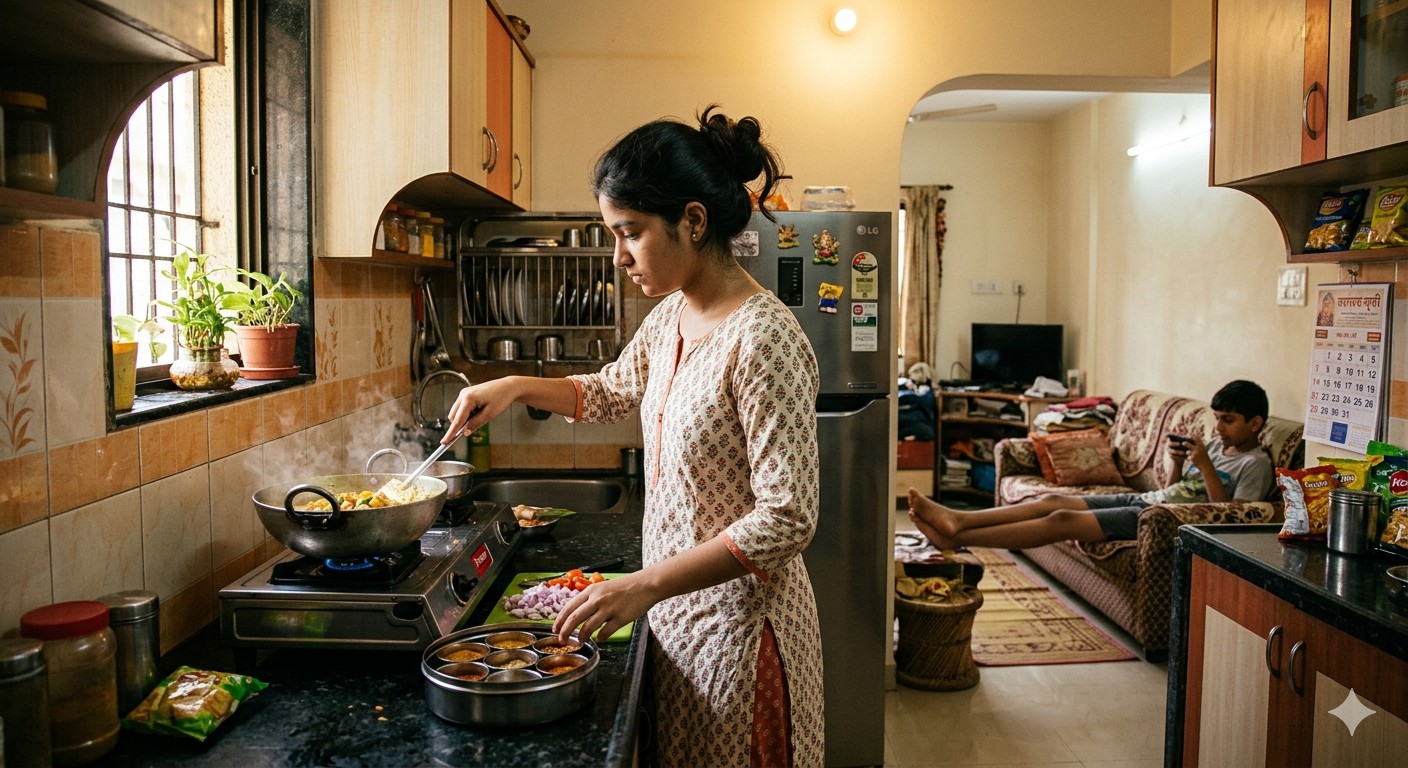
In a new study examining how the next generation of Indians spends their time, researchers from the Indian Institute of Technology Bombay have uncovered a persistent gender clock that binds adolescent girls to domestic labour. The research, published in the Journal of Population Research, reveals that Indian girls aged 15 to 19 spend an average of 105 minutes more per day on unpaid domestic and care work than their male peers.
This disparity is not a simple byproduct of poverty. The study warns that the heavy load of housework essentially steals time from hobbies and relaxation, potentially stunting future career prospects for girls.
The investigation undertaken by Prof Rama Pal utilised data from the Indian Time Use Survey (ITUS) 2019, covering over 40,000 adolescents across the country. It notes that approximately 75% of Indian girls participate in unpaid domestic activities daily, while for boys, such involvement is so rare that it is considered a statistical outlier. A particularly striking finding involves affluent families. That is, when mothers work, the gender gap for daughters actually increases.
Dr Pal explains that this happens because gender roles remain rigid even as income rises. “The affluent families are likely to have more educated women, employed in the formal sector with greater and fixed work hours. These work characteristics require greater substitution for domestic work,” says Dr Pal. “Moreover, studies have shown that wealthy families often follow strict gender roles for the unpaid work, as men rarely participate in domestic chores such as cooking and cleaning. Thus, adolescent girls are the most common substitutes.”
The study also highlights intersectionality, that is, how a girl’s experience changes based on her caste. Girls from the Scheduled Castes and Tribes face a double disadvantage, bearing a much higher work burden. While cash transfer schemes and targeted policies have successfully kept these girls in school, they haven’t yet addressed the work they do once they get home.
“The study does not find displacement of study time for girls due to this additional burden of unpaid work,” Dr Pal observes. However, she argues that policy needs to evolve, “a similar targeted approach is required to change boys’ mindset towards unpaid work and achieve greater gender parity.”
The real casualty of this domestic burden is leisure. Unlike study time, which remains relatively equal between genders, it is the time for hobbies, sports, and friends that girls lose. This loss has long-term consequences for a girl’s sense of self and her future.
“These leisure activities are crucial for leading a healthy life, building friendships, exploring new interests and even developing aspirations and career goals,” Dr Pal warns. “With a disproportionately higher burden of domestic work, girls’ career goals are likely to be set at lower levels, ensuring future financial dependence and continuation of gender roles.”
The research concludes that economic growth alone will not fix the “unpaid clock.” True progress requires a cultural shift that starts in childhood. Dr Pal points toward the New Education Policy (NEP), which introduces vocational training like cooking to all students, as a potential catalyst.
“Targeted interventions at the early stages of life, possibly in schools, will act as a catalyst for changing norms,” she says. “This initiative increases the exposure of children, regardless of gender, to this domestic task and is likely to change their perspective that cooking is the responsibility of women in the family.”
By valuing a girl’s time as highly as a boy’s, society can ensure that the next generation of Indian women isn’t just educated, but truly free to pursue their own ambitions.
| Article written by: | Sudhira HS |
| Image/ Graphic Credit to: | Lead image: AI-generated using Gemini |
| Link to Gubbi Labs: | - |