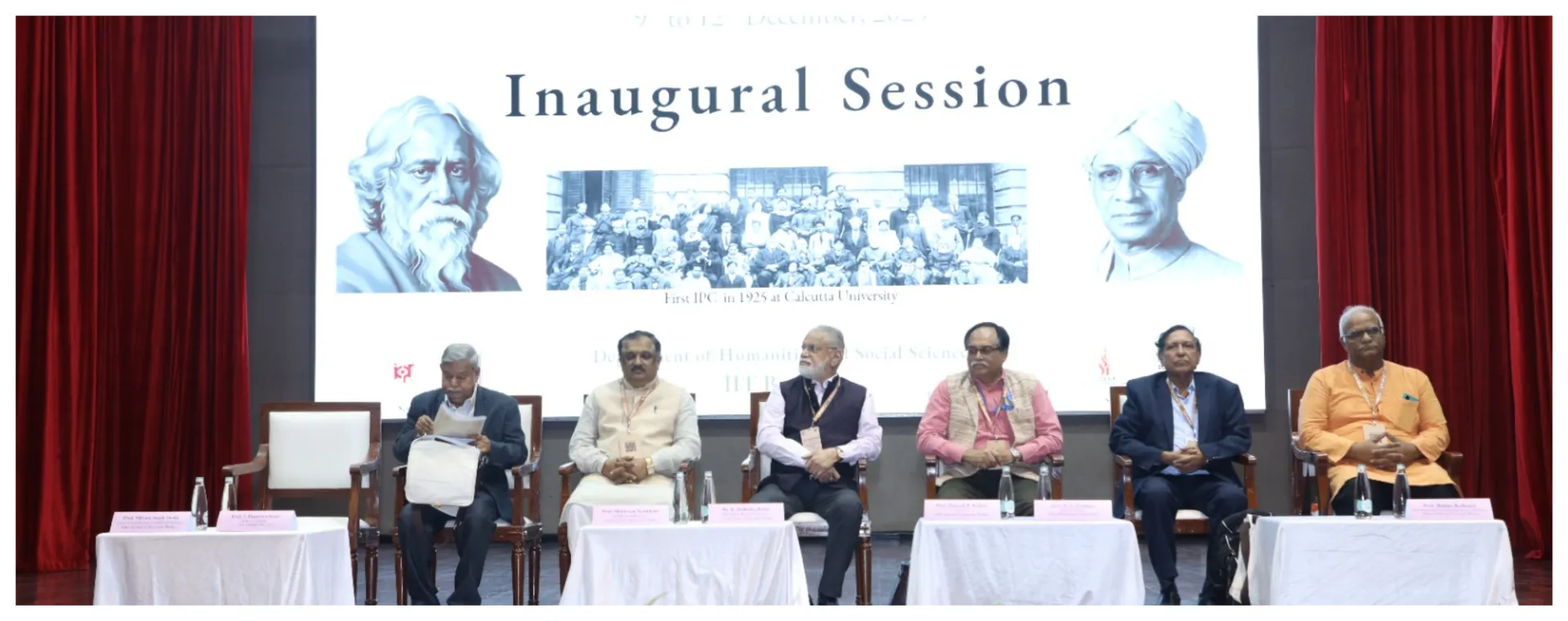

Dr. K. Radhakrishnan, Chairperson, Board of Governors, IIT Bombay and Prof. Shireesh B. Kedare, Director IIT Bombay inaugurated the Centenary Session of the Indian Philosophical Congress (IPC 2025) at the Convocation Hall, IIT Bombay on 9th December 2025. Prof. Shrinivasa Varakhedi, Vice-Chancellor, Central Sanskrit University, joined as the Guest of Honour.
The IPC, founded by Nobel Laureate Gurudev Rabindranath Tagore and the renowned philosopher and former President of India Dr. Sarvepalli Radhakrishnan, is one of India’s oldest academic forums. Its first session was held in 1925 at the University of Calcutta, with participation from many of India’s leading philosophers.
The session opened at 10:00 AM with an introduction to the centenary theme: Hundred Years of Indian Philosophy: Dialogue, Traditions, and Contemporary Challenges by Prof. Vikram Singh Sirola, one of the organising secretaries of IPC 2025. The Acting Head of the Department of Humanities and Social Sciences, IIT Bombay Prof. Malhar Kulkarni welcomed the dignitaries.
The Director, IIT Bombay Prof. Shireesh B. Kedare introduced the Chief Guest and delivered the Welcome Address. He emphasized the historic significance of hosting the Centenary Congress at IIT Bombay, noting that Science teaches us to ask how things happen and what needs to be done, whereas philosophy encourages us to ask why things matter and to confront deep questions of existence - questions as, Who am I?
Delivering the Chief Guest Address, Dr. Radhakrishnan highlighted the enduring relevance of India’s philosophical traditions and their vital dialogue with modern science and technology. He observed that Indian thought has long recognised the human being as an extraordinary creation endowed with consciousness and inner awareness, and that the love of wisdom, the philosophy of being, forms the bedrock of this heritage. Referring to Dr. S. Radhakrishnan’s exposition of Vedanta, he invoked the three prasthanas - the Upaniṣads, the Brahma Sutra, and the Bhagavad Gita as foundational texts shaping India’s reflective traditions. He underscored the rediscovery of Sanskrit literature as a transformative moment in the history of world culture. In the contemporary era of Big Science and Deep Technology, he emphasized, institutions of higher learning carry a special responsibility to ensure that technological progress is guided by philosophical insight and human values, fostering a meaningful alignment between innovation and wisdom.
The Guest of Honour, Prof. Varakhedi, reflected on the intellectual legacy of Sanskrit philosophical thought and its contribution to global knowledge traditions. Prof. S. Paneerselvam, General Secretary IPC, expressed appreciation for IIT Bombay’s efforts in reviving the IPC with renewed academic vigour.
The session concluded with a Vote of Thanks by Prof. Rajakishore Nath, marking the beginning of four days of intensive academic exchange, including plenary talks, round-table discussions, endowment lectures, a Śāstrārtha Sabhā, and presentations by researchers from universities across India and abroad.
IPC 2025 marks the largest congregation of philosophers, researchers and scholars in India to date. Over 450 peer-reviewed research papers are scheduled for presentation across sectional sessions. They will revisit the intellectual journey of Indian philosophy over the last hundred years and to initiate fresh conversations on its contemporary relevance and future directions. It will cover the important areas in the classical Indian philosophical systems, Indigenous Knowledge Systems and modern Indian thoughts. Special sessions are planned for Philosophy of Science and Technology, environmental ethics and AI.